Dev Journal 2 - Core Resolution and Enforcing Themes
Working with an existing SRD, why it was chosen, and how it enforces desired gameplay elements.

What the dice mechanic system is, at its most basic, is a system for aiding in decision making and inviting randomness into the thought process. The mechanics around this can aid in enforcing desired gameplay or hinder play. At their best, the mechanics are clean and get the job done without getting in the way of gameplay. At their worst, they actively inhibit having a good time playing the game.

Design Goals:
Simplicity - there is only one main system that does the bulk of the work, secondary systems and deviations from the core rule are eliminated where possible.
Flow - Making a roll should halt the game for the least amount of time possible.
Meaningful choices - players can make choices to impact outcomes, but it needs to be more meaningful than spending a metacurrency; it needs to impact the character in a real way.
Core Resolution:
I will be working with a base of the Year Zero Engine Standard Reference Document (YZE). (Link to SRD) I selected this because it has been shown to be a solid system to use for multiple genres, bringing a strong focus to the type of fiction it is emulating. From narrative Kids on Bikes of Tales from the Loop to somewhat simulationist gritty survival fantasy Forbidden Lands to folk tale mystery solving in 1800s Sweden in Vaesen to sci-fi cop noir with Blade Runner to sci-fi survival horror in Aliens, the YZE runs many great games.
The system is known to be somewhat narrative and mostly to get out of the way for gameplay purposes. It is also simple enough to learn and play quickly, while allowing the freedom to add additional mechanics, tweak existing ones, and even eliminate large chunks of unneeded pieces where they are not needed - without breaking.
Key things that draw me towards the Year Zero Engine are:
Limited Math - you are not adding modifiers to a roll, you are only looking for a 6 or higher on any die rolled. No math = faster (usually) resolution.
Dice Pool - I prefer the probability curve of a dice pool over a single die resolution. Mainly, the reduction of extremes works well for portraying competency as characters grow. In the YZE, you get a die for your stat, one for your skill, and maybe one for gear or other bonuses.
Step Die OR D6 Pool (or both!)- the SRD give rules for using step dice of multiple sizes and rules for only d6 dice to build the pool. The two are, probability of success wise, extremely close in their odds. Since it is a pool, you can even combine them without adverse effect - Free League does this in their Forbidden Lands games with artifacts of power.
Step Dice - I am using step dice in this game as it reduces cognitive load - you can get the same effect of rolling 10 six-sided dice just by rolling two 12-sided dice. As you get better at a stat or skill, your die size gets bigger -nothing > d6 > d8 > d10 > d12. This has a benefit of reducing rolling a 1, which can be detrimental - more on this later, but it makes a competent character less likely to critically fail.
D6 pool - This will likely be added with a conversion chart for those who like to roll gobs of shiny math rocks and enjoy the clicky-clack they make. Multiple d6s can be added to the pool for advantage dice given for clever thinking, gear, and situational boons.
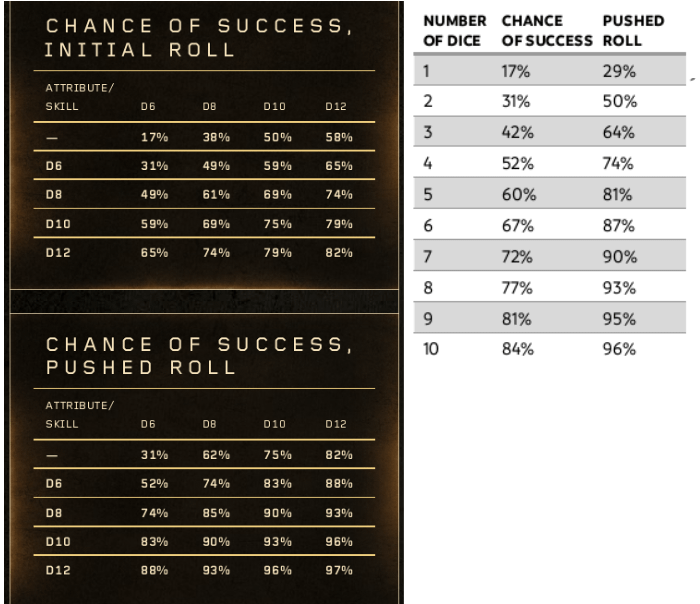
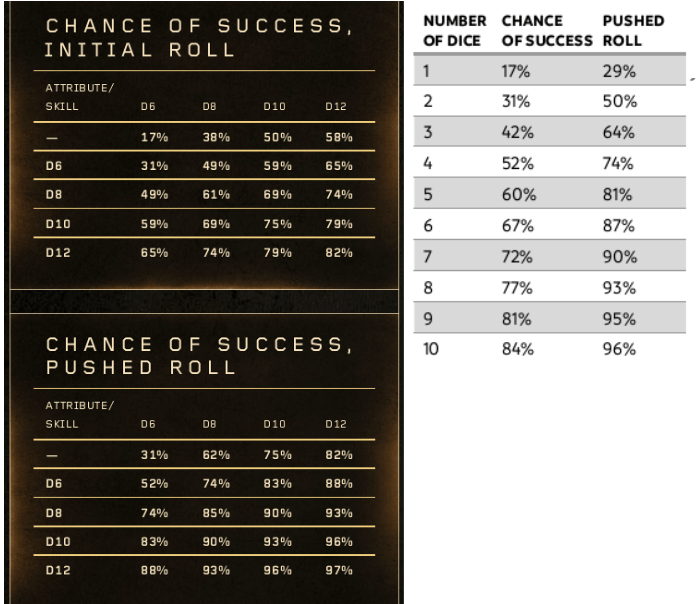
Odds of success with Step Dice and odds with Dice Pool. Chance of success is very similar.
Pushing Rolls - In some games, you roll, you fail, you move to next player. This does nothing to move the narrative along and feels bad with nothing you could have done to change it. I think every roll made should have possible consequences for failing, not be a binary success/fail state.
With the YZE, if you fail a roll, your character can sacrifice something to push your effort and reroll all dice not showing a one. This isn’t simply spend a nebulous meta-currency, it will damage your character in some way, similar to taking stress in Forged int the Dark games.
I really like this aspect of choosing if a roll is meaningful enough to gain a wound to try to succeed. In my game, pushing will be AT LEAST a partial success, you are rolling to save vs the impacts of your actions.Advancement - End of session questions to gain XP (did you do X? Gain 1XP) emphasize the desired gameplay even further - don’t want combat? Add a question about defeating foes without fighting. Want to emphasize magic? Add a question about using magic in an unexpected way. All questions that answer yes will go into a party pool of XP that players can spend from. This also emphasizes that they are a group and support each other; I can see it leading to conversations about spending XP to better the group - do I take the new ability or let Jim get a higher social to overcome the upcoming trade deal?
In summary, the core system is: build a dice pool of various sized dice based on your Stats, Skills, and any bonuses. If you fail, you can choose to sacrifice something and reroll to gain at least a partial success. At the end of session, answer questions to see how much XP you get and add it to the pool. Players can spend this on increasing stats, skills, or gaining new abilities.
This right here:
“Limited Math - you are not adding modifiers to a roll, you are only looking for a 6 or higher on any die rolled. No math = faster (usually) resolution.”
100%
I can’t stand a game with math (that slows things down). Warhammer Fantasy (while I love the setting) does this with a multi-step d100 add/subtract “success levels” craziness.
Although it is possible to ruin the simplicity of the Year Zero engine. Aliens, for instance, has got to be one of my all time favorite RPGs… but all the modifiers for equipment/weapons and “stunts” is overwhelming, and this really slowed our game down at first. I made a handout of a scaled down version of these modifiers to keep things moving.
Keep up the good work!